The plug built around the wall
The British plug is praised as the safest in the world and mocked as the biggest. Both views miss that it is the visible end of a wiring system designed in 1944, under shortages that no longer exist.
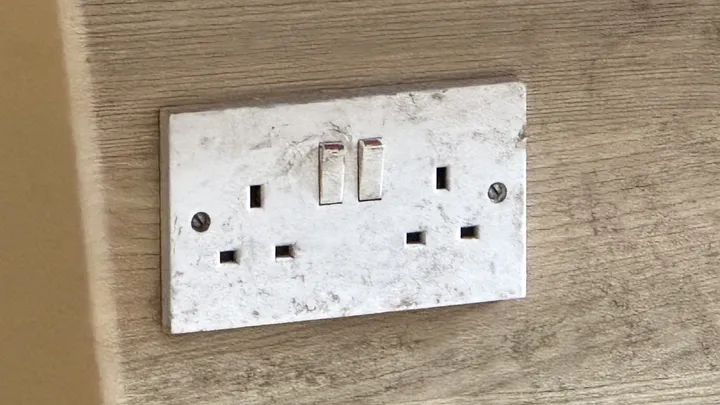
The thinnest laptop and the biggest plug
In the summer of 2009, a graduate of the Royal College of Art put the problem in two sentences. “’Mac book Air,’ Apple’s latest master-piece, is the world’s thinnest laptop ever,” wrote Min-Kyu Choi. “However, here in the U.K, we still use the world’s biggest three-pin plug.”
His answer was a plug that folds into “a 10mm thickness object” while still meeting the British Standard. It won the Brit Insurance Design of the Year award in 2010. What made the project striking was not the hinge. It was the premise: that the plug in every British home “is not considered in the process of designing for mobility”, sixty years after it was standardised.
The British plug has an unusual reputation. It is widely described, and not only in Britain, as the safest and best-engineered plug in the world. It is also widely mocked: for its size, for the agony of stepping on one in bare feet, and for the sight of a phone charger the size of a matchbox bolted to pins built to carry three kilowatts.
Both views treat the plug as a design that stands on its own, to be admired or ridiculed on its merits. It isn’t one. The plug is the visible end of a wiring system designed in the middle of a war, by a committee working for a ministry, for houses that had not yet been built, under shortages that no longer exist. Almost everything about it that people praise or complain about follows from a decision about the wires inside the walls.
This is the story of that decision, and of what happened when the devices plugged into it changed.
1942: a committee plans for houses not yet built
In June 1942, a year after the Blitz ended, the Minister of Works and Planning, Lord Reith, convened a committee of the Institution of Electrical Engineers. Its brief was part of a larger programme, the Post-War Building Studies: a “comprehensive and co-ordinated review of building techniques for the guidance of those who would be responsible for the direction and organisation of building after the war”. The committee met 22 times. Its report, Post-War Building Study No. 11: Electrical Installations, appeared in January 1944, with a supplement that July.
The report itself is hard to find today. What follows relies on the extensive quotations in a 2006 history by Malcolm Mullins, written for the IEE’s Wiring Matters. Mullins worked for MK Electric, the company whose design became the dominant British plug. His account is detailed and quotes the primary text at length, but it ends in advocacy (“a system that cannot be equalled in terms of safety, performance and convenience”). We take the quotations from him and leave the verdict.
What was wrong before the war
Pre-war Britain had standards, just too many of them. The BS 546 family of round-pin plugs came in 2, 5 and 15 amp sizes, each with its own socket. The pre-war logic was sound in its own terms: one socket on one fuse, with the plug size limiting what could be connected, so a small plug could never draw more than its flex could carry.
In practice, the committee found the arrangement “wholly unsatisfactory from the standpoint of the convenience of the consumer. The absence of an intermediate size between 5 and 15 amperes and the cost and dimensions of the 15 ampere [plug], have contributed to the use of non-standard socket-outlets and plugs to fill a gap in which there is substantial demand.”
Homes had too few sockets, and people improvised. Even in 1944, the committee worried about “the rapidly increasing number of these small consumption appliances”.
The constraints
Three pressures shaped what came next.
Materials. In Mullins’ summary, “it was realised that a post-war Britain would continue to suffer from a massive shortage of raw materials”, and the committee estimated that its proposals, the ring circuit together with single-pole fusing, would save “approximately 25% compared with pre-war regulations”.
That is the origin of the story, repeated almost everywhere, that the British plug exists because of a copper shortage. It is close to the truth but not quite it. In the passages available to us the report speaks of raw materials, not copper by name, and the saving belongs to the whole scheme, not to the plug. A later government pamphlet, Ministry of Works Technical Note No. 4 (1957), put the figure at “30% less cable” and about 25% of the wiring cost of a house. Copper is plainly the material at stake. But the record as we can read it is about economy in general, and the report puts convenience at least as high.
Housing. Construction had stopped during the war and a massive building programme would follow it. The committee recognised “at an early stage” that this pause, and the rebuilding to follow, was a chance to improve both safety and convenience. In effect, the best time to rewire a nation is before the houses exist.
Heat. The study assumed the small post-war house would be partly heated by electric fires plugged into the wall: “portable or inset electrical fires or convectors up to 2 kW rating”, in dwellings where “fires or other appliances exceeding this rating are seldom required due to the limitations imposed by the size of the room.” The heater, not the radio or the iron, set the size of the socket.
The plug they nearly chose
The popular history usually skips one detail. According to Mullins, “initially, a majority favoured a new British Standard for a 10 A, fused, shuttered socket-outlet and a plug with round pins conforming to BS 546.”
The committee’s first instinct, in other words, was evolution: keep the familiar round pins and add a fuse and shutters. But, Mullins continues, “the final unanimous decision was for a 3 kW (230V; 13 A) socket-outlet with fused plugs.” The manufacturers’ association, BEAMA, was invited to propose designs.
The report explains why it would settle on one design even if it was not everyone’s favourite: “The general benefit to be obtained from the widest use of a single standard is so great as to call for the subordination of individual preference, or even of comparatively minor technical consideration, to the choice of the alternative most likely to meet with general acceptance.”
That sentence is worth keeping in mind. The flat-pin 13 A plug was not handed down as the single correct answer. It was a negotiated settlement among workable options, chosen so that there would be one.
The system: a ring in the wall, a fuse in the hand
The ring
The committee’s central idea was not a plug. It was a way of wiring a house.
Instead of running a separate cable from the fuse board to each socket, a ring final circuit runs one cable out from the board, past every socket in turn, and back to the board again. Current can reach each socket by two paths, so a modest cable can carry a large total load, and new sockets can be added anywhere along the loop. One fuse at the board protects the lot.
The 1957 Technical Note made the case in a single comparison. A typical three-bedroom urban home wired the pre-war way needed at least nine 15 amp fuses. The ring did the same job with one 30 amp fuse serving fifteen sockets. “The ring circuit system of wiring takes full advantage of domestic load diversity,” it said, “because one circuit serves an unlimited number of standard socket-outlets.” The assumption of “diversity” is the key: not everything is switched on at once.
The catch, and the fuse
The ring creates a problem the old system never had. A 30 amp fuse at the board protects the cable in the wall. It does nothing for the thin flex on a table lamp, which could overheat and burn long before 30 amps flowed.
The pre-war system had dealt with this by making small plugs physically incompatible with big sockets. The ring abandons that: every socket is the same and sits on the same large fuse. So the protection has to move somewhere else, and it moves into the plug.
The Technical Note put it plainly: “A large fuse at the meter end of the installation that has to be capable of carrying the full load of current drawn from several socket-outlets at once may not protect a flexible cord leading from an individual socket. The way to ensure adequate and selective protection is to connect each flexible cord to a separately fused plug.”
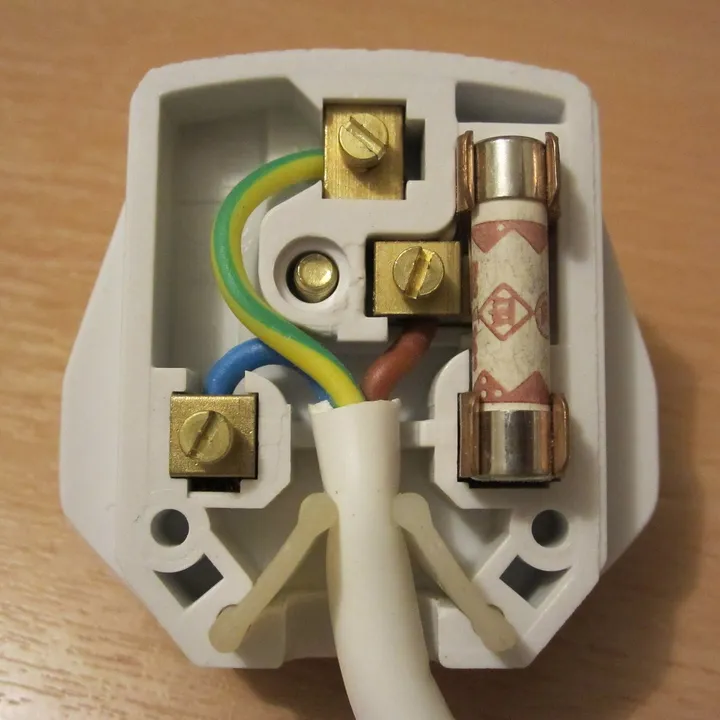
This is the single most important fact about the British plug. The fuse is not an extra layer of safety bolted onto a conventional design. It does a job that the wiring in the wall had stopped doing. The bulk of the plug body, the cartridge fuse inside it and the rule that each appliance’s fuse is matched to its cable all follow from the decision to wire houses in rings. Even the 1994 law that made fitted plugs compulsory ties the fuse to the appliance: it must be “rated in accordance with the appliance manufacturer’s instructions”.
A plug defined, a socket designed to fit
BS 1363 was published in 1947. It specifies the plug precisely and leaves the socket comparatively free. As the engineer David Peacock put it in a 2013 history for the IET: “there is a common assumption that a 13A mains plug is made to fit a 13A socket, but actually it is the other way round.” The pins’ size, shape and spacing are fixed. A socket designer may do almost anything, provided it accepts every compliant plug.
The standard also requires the earth pin to connect before the live and neutral pins do. That is why the earth pin is the longest of the three.
Shutters: made mandatory, not invented
The committee paid particular attention to children: to shutters, and to reducing damage by flush-mounting sockets “well above floor-level”. BS 1363 was, in Peacock’s timeline, “the first BS to require shutters”. The traditional mechanism uses the long earth pin to push the shutter aside, uncovering the holes for the other two.
The shutter itself was not new. Peacock records a shuttered socket from Crompton & Co as early as 1893, and an MK patent for an earth-pin-operated shutter “in the form still familiar today” in 1936. What 1947 changed was that shutters stopped being a feature of some sockets and became a condition of all of them.
The designs that lost
BEAMA’s invitation produced more than one 13 A plug. The Dutch-based Museum of Plugs and Sockets records rival designs from Dorman & Smith, patented in 1943, in which the fuse itself served as the line pin, and from Wylex. Neither became the standard, but both remained in use for about three decades. The MK design became the one Britain knows.
Why flat pins rather than round? The sources we could reach do not say, and we would rather leave the question open than supply a tidy answer that nobody recorded.
Seventy-nine years of amendments
A standard published in 1947 is still in force in 2026. That is true only in the sense that a house is the same house after eight decades of repairs. BS 1363 has been revised repeatedly, and almost every revision answers a problem the 1947 committee could not have seen.
Coexistence
The new plug did not sweep the old ones away. BS 546 round-pin sockets stayed in service for decades, and so did the rival 13 A designs that lost the standardisation contest. Peacock notes that some sockets now in use may date from 1947 itself. Plugs, attached to appliances that wear out, turn over far faster than sockets, which last as long as the plaster around them.
Shutters, refined
From 1957 the standard allowed a second way to open shutters, by pressing any two pins in at once rather than relying on the earth pin alone. Later designs from MK, Legrand and Hager use the earth pin to release a lock, which the other two pins then push open. The standard now also requires that a shutter cannot be opened by a continental two-pin Europlug. A British socket is built to refuse the most common plug in Europe.
1984: sleeved pins
In 1984 the standard began to require that the live and neutral pins be partly sleeved in insulation, so that the metal exposed on a partly withdrawn plug is the dead part. Peacock calls it “an additional level of safety”. Every older plug still in a drawer is the earlier, bare-pinned kind.
1994: the end of wiring your own
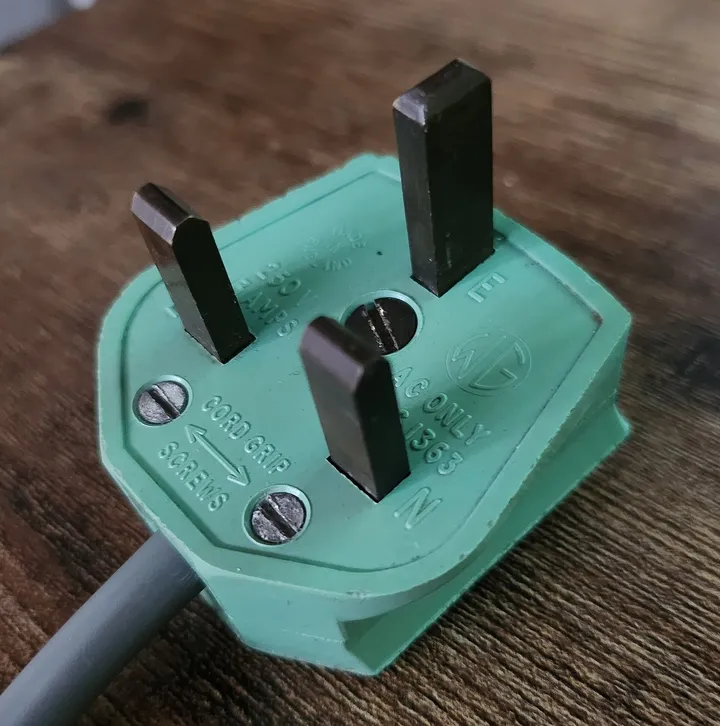
For nearly half a century after BS 1363 appeared, British appliances did not have to come with a plug. Buyers fitted their own: stripping the flex, attaching the three cores to the right terminals, choosing a fuse. The Plugs and Sockets etc. (Safety) Regulations 1994 changed that. Appliances had to be “correctly fitted with a standard plug” containing a BS 1362 fuse, a requirement in force for manufacturers from 1 February 1995 and for everyone else from 1 February 1996.
From then on, the plug that best embodies the 1947 committee’s idea of protecting each flex individually came already fitted, by people who knew the flex.
Things that only look like plugs
The standard controls plugs, and a whole category of objects fits into sockets without being plugs. Peacock lists the problems: chargers, travel adaptors and child-safety socket covers made with pins of the wrong size. A pin too thick can stretch the socket contact so that it no longer grips a proper plug, “with the potential risk of arcing and overheating”. Covers whose dummy earth pin is the wrong shape can damage the shutters they are meant to make safer. Peacock was a founder of FatallyFlawed, which campaigns against socket covers, and his warning is partisan as well as technical. But the mechanics he describes follow directly from a standard that defines the plug and lets the socket adapt.
Electronics move into the wall
In August 2016 a revised BS 1363-2 brought sockets with built-in USB charging inside the standard, with a new annex for the electronics. The 2023 revision went further. In the trade body BEAMA’s summary of the changes, it extends the scope to cover 50 Hz to 60 Hz, adds an “abnormal condition” test for USB charging circuits, admits sockets with built-in circuit breakers, and, in one line worth pausing on, forbids “the suspension of a plug or an adaptor in an inverted orientation unless permitted in the manufacturer’s instructions.” The 2016 editions were withdrawn on 30 June 2026.
The committee of 1942 designed a socket for a two-kilowatt electric fire. Its successors are now writing rules for phone chargers inside the faceplate.
Is it the safest plug in the world?
The honest answer is that nobody has shown it, and the claim usually rests on a list of features rather than a count of injuries. The features are real. What they prove is a different matter.
What the design protects against
Each feature answers a specific failure:
- The fuse protects the flex, because the ring’s fuse at the board cannot.
- The shutters keep a child’s hairpin away from live metal.
- The sleeved pins mean a plug pulled halfway out exposes no live metal.
- The long earth pin connects first and opens the shutters.
These are good answers. But at least one is an answer to a problem the system created for itself: the fuse cures a risk the ring introduced.
The comparison everyone makes
The usual foil is the American plug, and on one point the comparison is stark. Shutters were mandatory on British sockets from 1947. In the United States, the National Electrical Code first required “tamper-resistant” receptacles, its equivalent of shutters, in new homes in the 2008 edition. That is a gap of sixty-one years.
The case for the change was made by the US manufacturers’ trade body, NEMA. Drawing on Consumer Product Safety Commission data, it found that from 1991 to 2001 more than 24,000 American children aged ten or under were treated in emergency rooms for incidents involving electrical receptacles, “about seven children every day”. Most were under six, and the objects they inserted were things like hairpins and keys. NEMA noted in passing that “European electrical receptacles commonly use tamper-resistant shutters for intrinsic safety”. It also recorded resistance at home: some building professionals objected to the cost, which NEMA put at about fifty cents a socket.
It is a telling story: a protection Britain made universal before most of its post-war houses were built took the US six decades and a lobbying campaign. But note who is telling it. NEMA represents the companies that make the new sockets. That does not make its figures wrong. It means they are evidence for one protection, not a verdict on two plug systems.
The comparison that matters more
The stronger rival is not the American plug but the German one. The Schuko (from Schutzkontakt, “protective contact”) system traces to a 1926 patent by the Bavarian manufacturer Albert Büttner, with a Siemens-Schuckert patent of 1930 regarded as completing it. It earths through clips on the sides of a recessed socket, and the plug carries no fuse.
Schuko and BS 1363 are different philosophies rather than better and worse versions of one idea. The British system puts protection in every plug, matched to each appliance. The continental system keeps the plug simple, wires sockets on radial circuits, and protects at the distribution board. It accepts that the breaker may be rated above a thin flex. Mullins notes that the UK resisted that compromise for decades, and accepted “the Continental practice” only with the 12th Edition of its Wiring Regulations. Each is coherent on its own terms. The question that would settle which is safer is how many fires, shocks and deaths each produces per home, after allowing for everything else that differs between countries.
The missing number
We looked for that number and did not find it. England’s fire statistics record sources of ignition, including electrical distribution, but nothing we found compares outcomes across plug systems in a way that isolates the plug from the wiring, the appliances, the housing stock and the rest. Without such a comparison, “the safest plug in the world” is a claim about intentions and mechanisms. It may be true. It has not been measured.
And stepping on one
There is one hazard every British household agrees on. The plug is said to come to rest pins-up on the floor, and to be the most painful thing a bare foot can find in the dark. We found no data on either: no injury figures, and no measurement of how plugs land. The internet’s ranking of it above the Lego brick is folklore. We report it as folklore, and with sympathy.
Does the fuse still earn its place?
The 1944 committee designed for two-kilowatt fires. Today, many of the things plugged into British sockets are chargers drawing a few watts. That shift does not make the design wrong, but it changes what each part of it is for.
A three-kilowatt plug for a twenty-watt load
A 20 W charger draws less than a tenth of an amp at 230 V. It sits on pins and a fuse carrier sized for 13 A. Its flex is protected by a fuse it could never come close to blowing in normal use. The body is big because the 1947 plug had to hold a cartridge fuse and carry a heater’s current, and the charger has inherited the envelope.
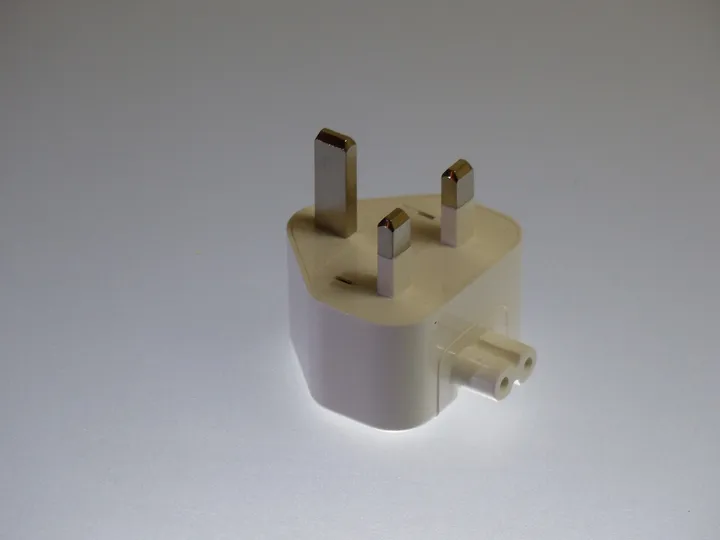
This is where Min-Kyu Choi came in. His complaint was practical: in a bag, the plug tears paper and scratches laptops. His fix kept every dimension the standard demands and changed only how they fold. He also designed a USB-charger version and a “Multi Flat Plug” that let three devices share one plug in roughly one plug’s space. The design that won the prize accepted the standard and worked around it. It did not challenge it.
When the big plug is a disguise
Size has one perverse consequence: it gives a counterfeiter room to hide. In February 2025 the charity Electrical Safety First reported on 116 counterfeit and look-alike Apple 20 W USB-C adapters bought in the UK and EU. Ninety-two per cent failed a critical insulation test that could expose the user to mains voltage. Of 22 opened up for closer inspection, 68% contained metal weights, added so that a fake with missing components would feel as heavy as the real thing. Seventy-one per cent of the UK samples failed a pin-strength test. A plug body built for a fuse and a heater’s current leaves plenty of empty space for that kind of fraud.
The charger moves into the wall
The obvious answer to a big plug for a small device is to have no plug at all. Sockets with USB ports built in are now common. In one sense they complete a story that began in 1944: there is no flex left for a fuse to protect.
But the risk does not disappear. It moves inside the wall. A USB socket puts a small mains power supply into the faceplate, next to the fixed wiring of the house, and its safety depends on keeping the 5-volt side properly separated from the 230-volt side.
Electrical Safety First tested exactly that. In a repeat of a 2014 study, run while the new USB rules for BS 1363-2 were still in draft, it bought nine USB sockets, from an unbranded product to the market leaders. Seven of the nine, 77%, failed on internal wiring and separation. Three had live parts that a test probe could reach. An unbranded sample passed only three of twelve criteria, and the most expensive product had just 1.74 mm of separation between mains input and USB output against a required 4 mm. The 2016 and 2023 revisions of the standard were, in part, the response.
Extension leads: where the fuse still earns its keep
The opposite case is the four-way extension lead, behind every desk and television in the country. Here the plug fuse does exactly what it was designed to do. A thin lead can be overloaded by too many devices, and the 13 A fuse in its plug protects it, whatever is on the ring.
The extension lead is also a quiet admission that the 1944 committee’s goal, enough sockets that nobody needs to improvise, was never fully met. The government’s 1957 Technical Note was already warning, in Mullins’ summary, that with too few sockets householders turn to trailing sockets that “become regarded as permanent wiring”. It argued that sockets had “long been regarded as an expensive luxury” and that economy was “wrongly thought” to come from having fewer of them.
Is the ring itself still the right idea?
The question at the root of all this is still open inside the profession. Current UK wiring rules, BS 7671:2018+A1:2020, permit both rings and radial circuits, and the IET’s Wiring Matters concludes that “each method should, therefore, be judged on its merits.” Critics point out that a broken ring can keep working with nobody noticing, that rings take longer to test, and that “two radial circuits use less cable” than one ring. Defenders point to the redundancy of two paths and to a 1994 report, commissioned by the Department of Trade and Industry and cited by Mullins, finding rings cheaper to install.
Both can be true under different assumptions about how many sockets a home needs and where the load sits. That the argument continues eighty years on says something about the original decision. It was a good answer to the question asked in 1944. Whether it is the right answer to today’s question is still being debated by the people who wire houses for a living.
A plug that fits only itself
For a traveller, the most consequential fact about the British plug is not its fuse. It is that it fits nothing else, and nothing else fits it.
PlugVerdict’s compatibility table records, for each of the 15 plug letters from A to O, which sockets each plug physically enters. The Type G row is a clean sweep: it fits a Type G socket and none of the other fourteen. In the other direction, no other plug type is recorded as fitting a Type G socket. That is deliberate. The standard explicitly requires that a Europlug cannot open the shutters.
The isolation is wider than it looks, because Type G travelled. In our country table, 55 of 243 countries and territories list Type G among their current sockets. For 20 of them it is the only type. They range from Ireland, Malta and Cyprus through the Gulf states, from Saudi Arabia to the UAE, to Singapore, Malaysia, Hong Kong, Sri Lanka, much of East and West Africa, and a string of Caribbean islands.
- Type G only (20)
- Type G alongside other types (35)
Too small to draw at this scale:
- Bahrain
- Dominica
- Gibraltar
- Grenada
- Guernsey
- Hong Kong
- Isle of Man
- Jersey
- Macau
- Maldives
- Malta
- Mauritius
- Saint Helena
- Saint Kitts and Nevis
- Saint Lucia
- Saint Vincent and the Grenadines
- Seychelles
- Singapore
In the other 35, Type G shares the wall with something else: Type D in Nigeria and India’s neighbours, Types C and M in Malaysia and Singapore, six different types in Myanmar and Jordan. For a traveller, these mixed countries matter most. A British plug that works in one room may meet a socket it cannot enter in the next.
Further reading
Histories of the plug
- Malcolm Mullins, “The origin of the BS 1363 plug and socket outlet system”, IEE Wiring Matters, Spring 2006. The fullest account of the 1942–44 committee, with long quotations from Post-War Building Study No. 11 and the 1957 Technical Note No. 4, both now hard to find. Mullins worked for MK Electric, whose design became the standard British plug, and his conclusion reads accordingly.
- David Peacock, “The remarkable evolution of BS 1363”, IET Wiring Matters no. 49, Winter 2013. A dated timeline of British plugs from the 1880s, with a clear explanation of why the plug is specified and the socket designed around it. Peacock co-founded FatallyFlawed, a campaign against socket covers, and the article ends on that theme.
- Museum of Plugs and Sockets, “History of British plugs and sockets”. An independent collector’s photographic history, good on the pre-war standards and on the 13 A designs that lost. Its page on Albert Büttner’s 1926 patent covers the origins of the German Schuko plug.
The standard and the law
- The Plugs and Sockets etc. (Safety) Regulations 1994, SI 1994/1768. The law that ended the era of wiring your own plug.
- BEAMA, 2023 Revision of BS 1363 Series: Summary of Key Technical Changes, June 2023. The manufacturers’ own plain-English summary of the latest revision. The standard itself is sold by BSI.
The ring circuit debate
- Michael Peace, “Back to the Forum: the ring final circuit”, IET Wiring Matters no. 80, May 2020. A short, even-handed summary of the case for and against rings, from the institution that writes the UK’s wiring rules.
Safety evidence
- Electrical Safety First, “Investigation into UK socket-outlets incorporating USB charging points” (archived copy). Nine USB sockets tested against a twelve-point checklist, with results by product. The charity’s original page has since been taken down.
- Electrical Safety First, “Counterfeiters are developing new and dangerous tactics”, February 2025. The study of 116 fake Apple chargers, including the metal weights.
- Andrei Moldoveanu, “Children and Electrical Outlets: An Opportunity to Enhance Safety”, IAEI News, November 2007. The US manufacturers’ case for tamper-resistant sockets, with the CPSC injury figures behind the 2008 code change.
The folding plug
- Marcus Fairs, “Folding Plug by Min-Kyu Choi”, Dezeen, 29 June 2009. Choi’s own description of the project, with photographs.
To watch
- Tom Scott, “British Plugs Are Better Than All Other Plugs, And Here’s Why”, 2014. Four minutes making the popular case for the plug, feature by feature.
- Big Clive. Long-running teardowns of cheap chargers, sockets and adaptors: the best way to see what is, and isn’t, inside the plastic.